One hardened node. Everything onboard.
Power, compute, sensing, and dual connectivity in a single rugged unit — designed to be thrown into the field in minutes and left to work for weeks.

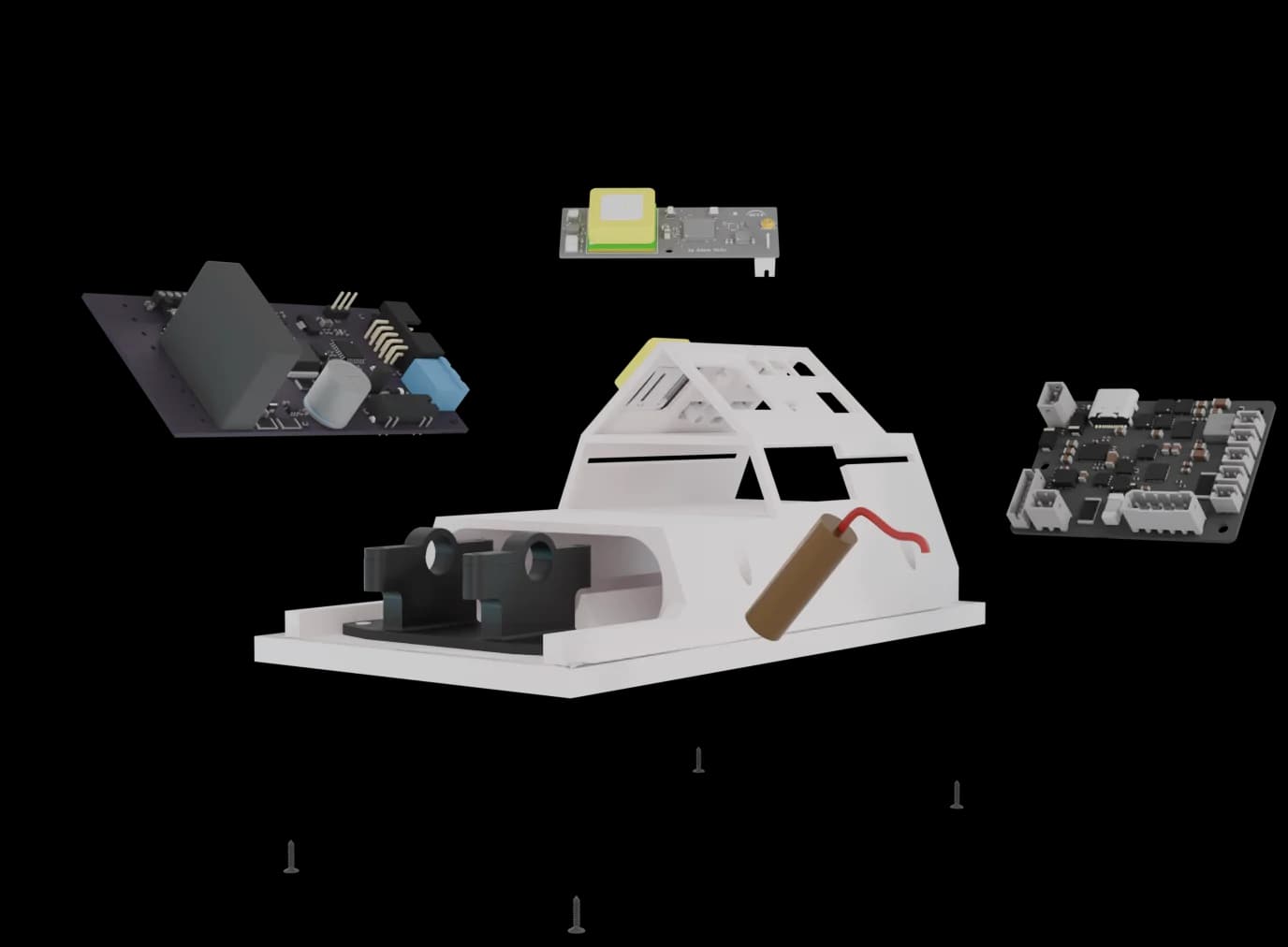
The node, opened up: sensor bay, radio & GPS, embedded computer, and power — each module detailed below.
Sensor module
A swappable payload for any mission.
The sensor bay is modular by design. Our first payload is radiation detection for defense, civil protection, and emergency response — but the same bay accepts gas, weather, or custom sensors. Partners bring the sensor; the node provides everything around it.
Radio & GPS
Two radios. One that never gives up.
A LoRaWAN uplink handles long-range, low-power communication through existing gateways — and a MeshCore radio lets nodes form their own self-healing network when infrastructure is damaged or denied. Onboard GPS places every reading on the map automatically.
Embedded computer
Processing at the edge, not just in the cloud.
An embedded computer runs the firmware that manages sensing, power, and communication. Readings are processed and stored locally, so a node that temporarily loses contact keeps measuring — and syncs its full history the moment a link returns.
Power
Built to run unattended.
A battery system with onboard management is sized for long, unattended deployments — days to weeks of continuous monitoring without anyone visiting the site. The firmware senses often, transmits smart, and sleeps whenever it can.
Enclosure
Hardened for the places we send it.
The enclosure is designed for rough handling and rough environments: dropped by hand, delivered by drone, left outside in the weather. Ruggedization is proven the honest way — in field testing with pilot partners.
A working prototype, end to end.
The full chain runs today: the node senses, LoRaWAN and MeshCore carry the data, and readings land live in the app. What's left is hardening it for the field with pilot partners — and we say so, rather than publishing invented spec sheets.
Sensor payload
Radiation detection integrated
Communication
LoRaWAN uplink + MeshCore mesh
Positioning
Onboard GPS
Edge & data
Processing, storage, pipeline
Live app
Map, readouts, alerts
Unattended runtime
Days to weeks per deployment
Ruggedization
Environmental ratings
Final form factor
Weight & dimensions
From CanSat to the field.
The node's architecture — sensor payload, embedded flight computer, radio link, and battery system in one small package — was first built and tested through our CanSat program in 2025–2026. That work is where our integration experience comes from, and it's the foundation today's working prototype is built on.